WordPress vs. Next.js: The Right Technology Can Transform Your Business
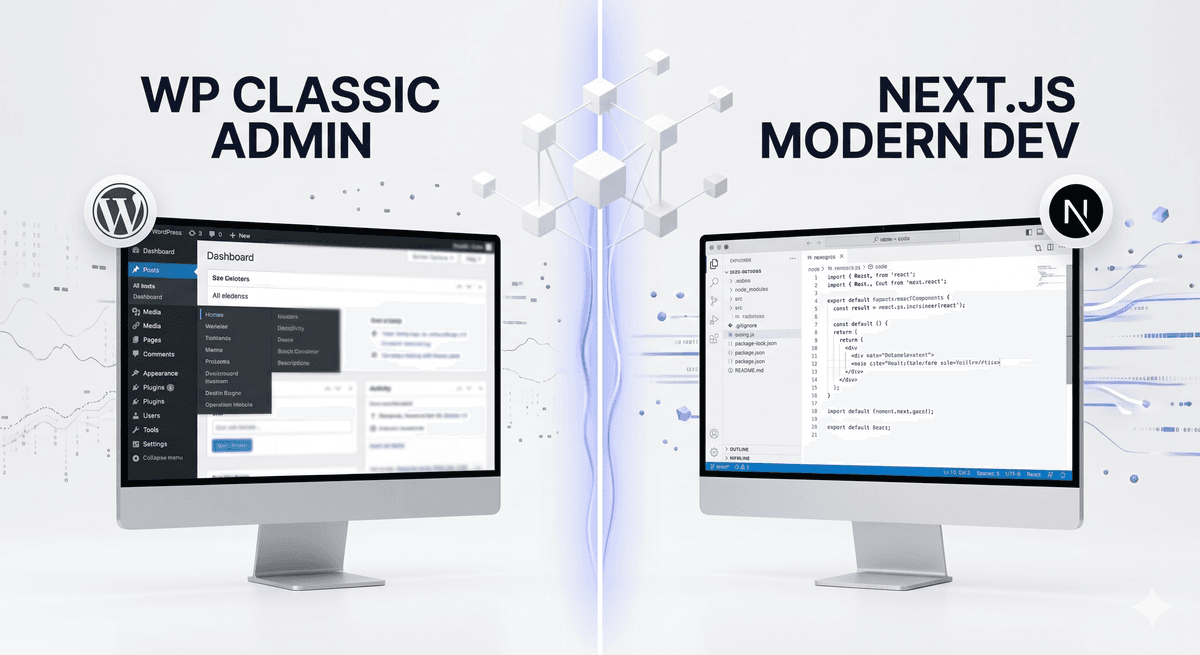
When you come to us with a new project, one of the first questions we ask is: "What do you want your website to do in 3 years?" The answer to that question largely determines which technology we build with. And most often, the debate comes down to the same duel: WordPress or Next.js.
Neither is wrong in absolute terms. But one of them is probably wrong for you.
What is WordPress?
WordPress launched in 2003 as a blogging platform and evolved into the most popular CMS in the world — today it powers approximately 43% of all websites on the internet. It's open-source, has a huge ecosystem of plugins and themes, and can be configured by someone without programming knowledge.
That's precisely its strength — and its weakness.
What is Next.js?
Next.js is a modern framework built on React — the technology used by Facebook, Airbnb, and Netflix for their interfaces. It's not a CMS in the traditional sense, but a tool for developers building websites and web applications with maximum performance and flexibility.
At Pixy Studio, Next.js is the technology we default to for new projects. Not out of technical snobbery, but because the results are measurably better for our clients.
Speed — and why it matters more than you think
Google has officially confirmed: loading speed is a ranking factor. A website that takes 4 seconds to load loses an average of 25% of visitors before they even see the first page.
A typical WordPress site, with a few plugins installed, easily reaches 3–6 seconds load time. Not because WordPress is bad, but because plugins add unnecessary code, database requests multiply, and pages are generated dynamically on every visit.
A site built with Next.js generates pages in advance — when someone accesses your site, they receive a ready-made HTML file, not one built in real time. The result: load times under 1 second, Google PageSpeed scores of 95–100, and an experience that converts.
Security — the problem WordPress can't solve on its own
WordPress is the most attacked platform on the internet. Not because it's insecure by design, but because it's so popular that it's worth the effort for attackers. Vulnerabilities most often come from outdated plugins and themes.
- Nearly 70% of hacked WordPress sites were compromised through vulnerable plugins
- A WordPress site requires constant updates — WordPress core, themes, plugins — all can introduce vulnerabilities if ignored
- Brute-force attacks on the login page are so common that there are plugins dedicated exclusively to blocking them
Next.js has no exposed database, no publicly accessible admin panel, and doesn't depend on a third-party plugin ecosystem. The attack surface is radically smaller. That doesn't mean it's invulnerable — no system is — but it means you don't wake up in the morning with your site hacked and redirected to a gambling website.
Flexibility and scalability
WordPress works well for relatively standard sites — presentation, blog, online store with WooCommerce. But if you want something outside the template — a platform with authentication, a product configurator, an interactive section — you quickly hit the limits of its architecture.
Next.js is, at its core, code. You can build anything you can imagine: pages that personalize based on the user, integrations with any API, complex animations, non-standard checkout flows. There's no "it can't be done" for technical reasons.
Moreover, Next.js scales effortlessly. A site with 100 visitors per day behaves identically to one with 100,000 — pre-generated pages don't put pressure on the server regardless of traffic.
The admin panel — the myth that WordPress is easier to edit
Many choose WordPress because "they can edit it themselves". In reality, things aren't quite that simple. The admin interface, especially with Gutenberg or page builders like Elementor, quickly becomes cluttered and difficult to use without experience.
A small change can affect a page's layout, break the design, or introduce errors that are hard to spot. Instead of saving time, you end up spending hours trying to fix things or searching for solutions.
In our approach, things are different. We build stable, optimized sites, and changes are made in a controlled way — either on a one-off basis or through a maintenance subscription. This keeps the site fast, consistent, and free from the risk of being accidentally "broken".
For most businesses, it's more efficient to focus on your core business while the technical side stays in the hands of someone who deals with it daily.
Long-term cost
WordPress seems cheaper at first. But factor in the hidden costs:
- Premium plugins: €50–300/year each, and you need several
- Performant hosting: A fast WordPress site requires managed hosting (WP Engine, Kinsta) — €30–100/month
- Maintenance: Constant updates, resolving plugin conflicts, backups — billable hours every month
- Post-hack cleanup: If your site is compromised, cleanup costs a few hundred euros and several days of stress
A Next.js site has lower hosting costs, zero plugins to pay for, and minimal maintenance.
When does WordPress still make sense?
We'll be honest: there are scenarios where WordPress can be a suitable choice.
- You already have a working WordPress site and don't want a complete rebuild
- You need an online store based on WooCommerce and its plugin ecosystem
- Your budget is very limited and you need a quick solution
- Your internal team already uses WordPress and you don't want to change the workflow
In these cases, WordPress can be a practical short-term solution.
We don't develop WordPress sites. We focus exclusively on modern solutions built with Next.js, where we can guarantee performance, security, and full control over the final result.